October 22, 2025
Five-Minute Brief: Unlocking the Commercial Real Estate Sector on Housing Affordability


To address Canada’s housing affordability crisis successfully, the public and private sectors must work collaboratively on solutions. In this Brief, we outline what is driving the issue, share our perspectives on the roles commercial landlords are uniquely positioned to play in rental housing and our recommendations for how firms can take meaningful action.
Introduction
Housing and Infrastructure Canada describes the current housing crisis as stemming from decades of underinvestment by governments of all political stripes and restrictive planning that slowed construction while population growth accelerated. Rising costs, municipal fees and limited supportive housing compounded the shortage, leaving housing supply far behind demand. Low-income households remain most affected, but middle-class households are also increasingly under strain.[1]
While consensus exists on the issue, there are differing perspectives on its drivers and how best to enact solutions. For example, some have raised concerns that financial firms, including real estate investment trusts (REITs), private equity and other institutional investors may drive rental housing unaffordability since their business models inherently require them to deliver returns to investors, in part through raising rents.[2],[3] Industry advocates rebut these arguments by asserting that real estate investment companies and commercial landlords play a key role in providing the capital required to maintain Canada’s aging rental housing stock and construct new purpose-built rental properties.[4],[5],[6],[7] REITs in particular claim they are positive contributors to affordable housing since they offer most of their units at prices affordable for median incomes.[8] Moreover, they highlight that REITs own less than 3% of the total rental apartments in Canada, making them price takers rather than price makers.[9]
In this Brief, we do not assume a one-size-fits‐all definition of affordability nor credit any single actor with sole responsibility. Instead, we argue that meaningful progress requires precise definitions, a clear understanding of roles across sectors and a focus on targeted interventions backed by appropriate incentives and partnerships.
The Importance of Definitions
Too often, affordable housing is used as a blanket term, creating confusion and potential misunderstanding about which interventions are appropriate by whom and to whose benefit. While complex, specificity and nuance are important when discussing how best to address affordability. Affordability is not a universal concept or metric; it must be contextualized by region, income, household type and housing form. Affordable housing in Canada is conventionally defined as housing costing less than 30% of a household’s pre-tax income.[10] Affordable housing encompasses several distinct categories that each play a different role in the ecosystem and can be provided by the private, public or non-profit sectors.[11] The following definitions illustrate how affordability can take different forms across income levels and housing types.
- Transitional housing: Subsidized units for temporary tenure with wrap-around supports, such as counseling or assistance with personal care. Intended as a stopgap measure between homelessness and/or emergency shelters and permanent housing[12]
- Supportive housing: Subsidized housing with wrap-around supports intended for long-term or permanent tenure[13]
- Community housing: Designed to serve low to moderate-income households, typically facilitated through rent-geared-to-income (RGI) subsidies that may rely on public or non-profit delivery to maintain long-term affordability[14]
- Affordable housing: Without any other modifiers, affordable housing typically refers to units that are rented at rates not more than 30% of the local median pre-tax household income[15]
- Market rental: Rental units that are not subsidized, where tenants pay the current going rate for the unit in the local market[16]
- Purpose-built rentals: Housing built specifically for long-term rental
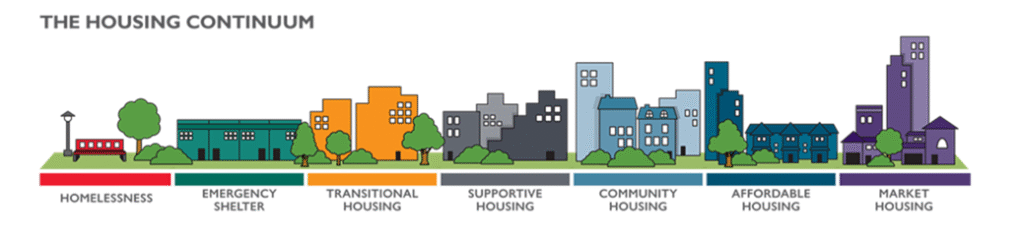
Source: CMHC, 2018
A Shared Responsibility
No single sector can meet the full spectrum of rental housing needs required to address Canada’s housing crisis, nor can any one strategy serve as a solution to a challenge of this scale and complexity. Progress depends on coordinated action — where effective public policy works alongside the ingenuity and agility of the private sector to build a society in which Canadians are securely and affordably housed.
Globally, the private sector’s strength lies in delivering housing at scale by attracting capital. Typically, the sector provides market rentals and some affordable units when supported by publicly funded incentives, or when partnering with non-profits to cross-subsidize affordable units within mixed-income projects or as required by inclusionary zoning policies. While there are examples of private sector companies and investors that specialize in providing housing affordable to low and very-low-income households, these models remain the exception rather than the norm. In many regions, housing that is affordable for very low- and low-income households is enabled through public funding or is delivered by non-profit or community-based organizations.[17]
In many regions, the cost of developing new rental housing has risen so sharply that even standard market-rate projects often struggle to deliver sufficient returns. This makes it extremely difficult for private developers to produce new affordable housing without public incentives or subsidies. When it comes to existing housing stock, the barriers are different. Operating affordable or RGI housing can require financing and management approaches that differ from the private sector’s typical expertise, including coordination with subsidy programs and community service partners.
Prime Minister Mark Carney has placed housing and affordability at the centre of his 2025 agenda. Recognizing the importance of public investment, the federal government has committed to doubling the country’s annual housing starts to 500,000 homes per year within the decade. A cornerstone of this plan is the creation of a new Crown Corporation, Build Canada Homes, which will oversee the construction of affordable housing on public land through public and private partnerships. The agency aims to build 4,000 factory-built homes on federal land across six cities, with the capacity to scale up to 45,000 units. Additionally, the CAD 1.5 bn Canada Rental Protection Fund will be introduced to support the acquisition of at-risk rental apartment buildings, ensuring they remain affordable in the long term. Other elements of the platform, including modular construction support, are designed to incentivize private sector participation, recognizing the need for more collaboration between diverse stakeholders to unlock supply and improve affordability. The upcoming federal budget, to be released November 4, will add further clarity on how well-resourced and feasible these initiatives will be.
Recommendations for Catalyzing Change
Financial housing providers are ultimately driven by their fiduciary duty to generate profits; however, this does not inherently preclude them from contributing alongside other actors to solutions to the affordability crisis. In fact, in our experience, many firms are interested in playing a positive role by taking credible, effective action.
Below, we share our recommendations for how to do so:
As foundational principles:
- Transparency should underpin all actions addressing affordability. Firms should communicate claims and strategies with integrity to avoid impact washing, such as overstating the positive change a particular initiative will deliver. This is essential for maintaining credibility and trust with investors, tenants, communities and regulators. Frameworks like the Impact Principles are helpful for clearly defining intentions and disclosing how impact considerations are embedded throughout your approach
- Recognize inherent business model limitations by supporting the need for public investment and multi-actor solutions to provide housing for very-low, low and middle-income households
Approaches to address the challenge can have different objectives:[18]
- Do no harm or avoid harm: As a precautionary principle, investment and development teams can evaluate affordability impacts in their due diligence risk assessments, as well as when setting rents, applying for above-guideline rent increases (AGIs) and disposing of affordable units to identify and mitigate undue contributions to the affordability crisis, as well as avoid reputational risks as scrutiny increases. By explicitly considering the management of existing stock, firms can address one of the most significant ways commercial landlords can contribute to housing unaffordability
- Benefit stakeholders: Clearly define the role your firm intends to play, the stakeholders you aim to serve and the affordability outcomes you hope to improve. Tailor your approach to your firm’s strategies, strengths and risk appetite, embed these objectives into core processes (development, investment, property management, community relations) and establish meaningful key performance indicators for success
- Contribute to solutions: Explore opportunities to shift industry norms and innovate. Participate in advocacy efforts to drive change at the systems-level through supporting programs and incentives that encourage the preservation and creation of affordable housing. Engage with communities and other stakeholders to co-design tailored solutions. Leverage blended funding models by partnering with public, philanthropic and other private capital sources
The examples below highlight three primary roles real estate investment firms can play in advancing housing affordability through both new development and responsible management of existing housing stock.
Role 1: The Partner
Collaborating with governments, non-profits and community stakeholders to preserve and/or deliver purpose-built affordable housing.
- KingSett Affordable Housing Fund aims to deliver stable returns while delivering high-quality affordable housing in Canada’s core rental markets. In 2024, the fund closed on the acquisition of Birchmount Green. The entire 220-unit property is either RGI, supportive or affordable housing and 93 units are filled through partnership with community non-profit organizations
- Ayrshire Housing Impact Funds focus on establishing partnerships with non-profits, governments and community stakeholders to deliver purpose-built multi-family rentals for underserved and marginalized groups. 20% of all units they build are rented at less than 30% of median household incomes. With community partners and philanthropic capital pools, they can steepen the rent discounts on these units
- The Daniels Corporation has played an integral partner role in the Regent Park revitalization in Toronto. Since 2005, Daniels and Toronto Community Housing have delivered over 3,000 market condos, nearly 400 affordable rental homes and 1,261 RGI units. Daniels selected Fred Victor, a nonprofit, as the affordable housing operator for approximately 65 units embedded within a new condominium at 500 Dundas Street East. The non-profit will purchase these units at cost and provide wrap-around services
Role 2: The Innovator
Developing new technologies or approaches to accelerate the scale of increasing rental housing supply.
- Assembly is advancing affordable housing delivery through modular and prefabricated construction. Their prefabricated approach allows rapid on-site assembly and provides greater cost certainty than traditional methods. Features such as passive design enhance energy efficiency, making it more affordable for tenants to heat and cool. The company has delivered affordable housing projects in partnership with municipalities and community housing providers, demonstrating how innovation in construction can expand access to sustainable rental supply. Industry estimates indicate that modular and prefabricated construction can reduce build times by up to 50 per cent and costs by as much as 20 per cent compared to traditional methods.[19] By enabling the delivery of high-quality rental units quickly and reliably, Assembly shows how technology-driven innovation can meaningfully support housing affordability
Role 3: The Preserver
Maintaining existing affordable housing options by directing dispositions to cooperatives, non-profits and community land trusts that qualify for rental protections, such as the Canada Rental Protection Fund or the BC Rental Protection Fund.
- In 2024, Canadian Apartment Properties REIT (CAPREIT) sold five properties to non-profit providers of affordable housing. The BC Rental Protection Fund supported the purchase of two properties by the New Vista Society. These non-profit organizations ensure the apartments remain affordable while enabling CAPREIT to reinvest in new supply
Turning Principles into Practice
At Quinn+Partners, we work with residential and commercial real estate developers and investors, pension plans, REITs and impact investors to turn these recommendations into actionable strategies. We help clients define their objectives, integrate them into core business processes, measure and report outcomes and communicate performance with credibility. We also facilitate industry collaboration by bringing together value chain actors to brainstorm and develop new approaches. By partnering with Q+P, your firm can ensure transparency, mitigate reputational risk, and make measurable, meaningful contributions to addressing housing affordability challenges while building trust with investors, tenants and communities. Please get in touch to learn more.
[1] (Housing and Infrastructure Canada, 2024)
[2] (August & St-Hilaire, 2025)
[3] (Pomeroy, 2023)
[4] Purpose-built rentals can be defined as housing designed and constructed from the ground up for long-term tenancy
[5] (CBC News, 2024)
[6] (Haider & Moranis, 2022)
[7] (Brooks & Lougheed, 2025)
[8] (Canadian Rental Housing Providers for Affordable Housing, 2025)
[9] (Canadian Rental Housing Providers for Affordable Housing, 2025)
[10] (Canada Mortgage and Housing Corporation, 2018)
[11] (Canada Mortgage and Housing Corporation, 2018)
[12] (Novac, 2009)
[13] (Ontario Health at Home, 2025)
[14] (City of London, 2025)
[15] (Canada Mortgage and Housing Corporation, 2018)
[16] (National League of Cities, 2024)
[17] (Organisation for Economic Co-operation and Development, 2024)
[18] (Impact Frontiers, 2025)
[19] (Fariha, 2025)